

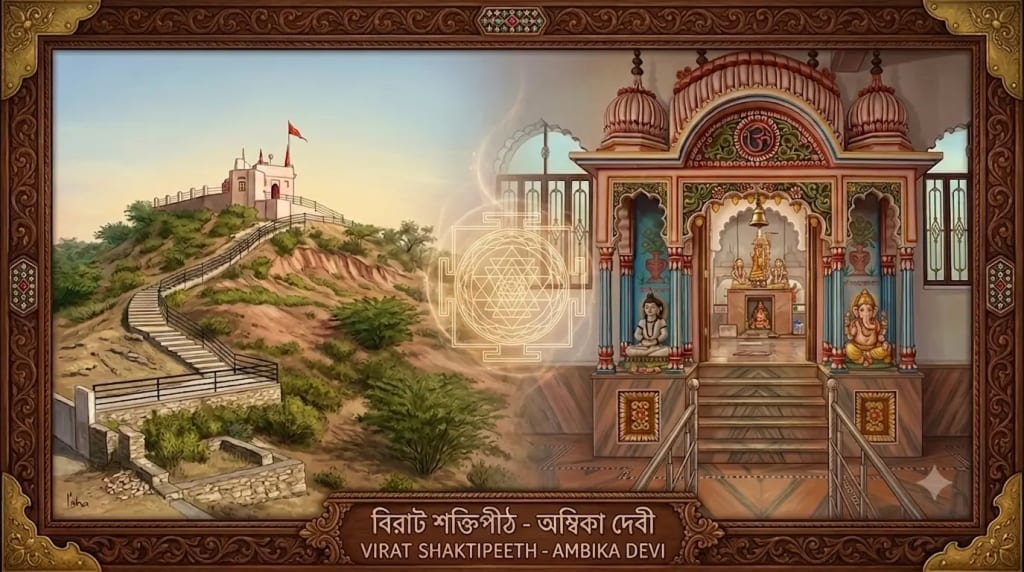
Virat Shakti Peeth, peacefully situated in the ancient town of Viratnagar (historic Bairat) in the Jaipur district of Rajasthan, is a highly revered pilgrimage site marking the spot where Goddess Sati’s toes (Pada Anguli) fell. Set against the rugged, scenic backdrop of the Aravalli hills, this sacred node is dedicated to Goddess Ambika—the universal mother and divine protectress—and guarded by her consort, Lord Shiva as Amritaksha Bhairav. The temple grounds, locally associated with the historic Mansa Devi shrine, exude a profoundly peaceful, meditative energy that offers modern seekers an immediate feeling of spiritual grounding and deep emotional healing.
🏛️ Overview of the Holy Landscape
The temple complex showcases classic Rajasthani architectural styles, featuring a majestic white shikhara and a small, serene stone courtyard. Situated atop a gentle hill in Papri village, reaching the sanctum requires a short climb of about thirty steps, offering panoramic views of the surrounding ancient landscape. Inside, the quiet, incense-scented inner sanctum houses the sacred representation of Goddess Ambika, creating a highly contemplative and intensely meditative atmosphere.
📜 The Sacred Legend of Sati’s Toes & Goddess Ambika
According to ancient Puranic scriptures, when Lord Vishnu severed Goddess Sati’s mortal remains to calm Shiva’s devastating cosmic dance, her left toes fell at this location in the ancient Matsya kingdom. In spiritual anatomy, the toes represent the ultimate ground points of the physical body, symbolizing forward movement, balance, and the strength to tread one’s life path with stability. The Goddess manifests here as Ambika, representing unconditional motherly protection, while Lord Shiva stands guard as Amritaksha, the “nectar-eyed” Bhairav who blesses devotees with spiritual clarity and ultimate liberation.
⏳ Temple History & Monastic Legacy
The history of Viratnagar is deeply intertwined with the Mahabharata, celebrated as the capital of King Virata where the Pandavas spent their final year of exile in disguise (Agnatavasa). Local folklore states that Yudhisthira prayed to the Goddess at this very site to seek protection and success before reclaiming their kingdom. Preserved perfectly over generations by local priestly lineages, the shrine successfully bridges historic epic lore with high-vibrational regional traditions.
✨ Spiritual Significance & Unique Blessings
- Awakening of Root Energy: Worshipping where the toes fell is believed to stabilize the root energy center, helping seekers overcome existential fears and gain immense life direction.
- Protection and Shelter: Devotees pray to Goddess Ambika to safeguard their families, shield them from false accusations, and successfully navigate critical life transitions.
- Resolution of Obstacles: Praying to Amritaksha Bhairav is believed to dissolve mental confusion, clear past karmic blocks, and restore inner peace.
⏰ Darshan Timings & Daily Rituals
- Public Darshan: Open daily from 05:30 AM to 08:00 PM.
- Pratah Aarti: 06:00 AM. A quiet morning invocation accompanied by traditional prayers.
- Sandhya Aarti: 07:00 PM. A beautiful evening lamp ritual with rhythmic bells that creates an atmosphere of profound devotional energy.
🚶 How to Reach Virat Temple
- By Road: Located in Viratnagar, about 90 km from Jaipur; well-connected via regular buses and private taxis along the Jaipur-Alwar highway.
- By Train: Alwar Railway Station (approx. 60 km away) is the nearest major railhead, with local cabs readily available outside.
- By Air: Jaipur International Airport (JAI) is the closest domestic and international airport, situated roughly 95 km away.
🗺️ Nearby Places to Visit
- Bhim ki Dungari: A massive, historic cave in Viratnagar believed to be the dwelling of Bhima during the Pandavas’ exile.
- Bijak ki Pahadi: A scenic archaeological hill housing the historic ruins of an ancient Buddhist monastery and Emperor Ashoka’s rock inscriptions.
- Viratnagar Museum: A local treasure house displaying ancient terracotta artifacts, coins, and medieval sculptures from the region.
💡 Essential Travel Tips
- Plan Around the Focus Keyword: Give yourself at least an hour to sit in quiet contemplation in the hillside courtyard of the Virat Shakti Peeth to absorb its serene, ancient energies.
- Best Time to Visit: The cooler winter months (October to March) offer the most comfortable weather for climbing the hill and exploring the local ruins.
- Dress Code: Traditional, modest clothing is highly recommended; all leather goods must be removed before entering the temple platform.
❓ FAQs
Why is Virat Shakti Peeth famous?
It is highly celebrated as the sacred spot where Goddess Sati’s left toes fell, uniquely integrated within the historic, Mahabharata-era landscape of Viratnagar.
Which body part of Goddess Sati fell here?
Her left toes (Pada Anguli), representing physical grounding, structural balance, and life path direction.
Who is the Bhairav at this Peeth?
Lord Shiva is worshipped here as Amritaksha Bhairav, the merciful protector and bestower of spiritual immortality.
Can we visit this temple on a day trip from Jaipur?
Yes, Viratnagar is located just 90 km from Jaipur and can easily be explored comfortably as a day trip by road.


