

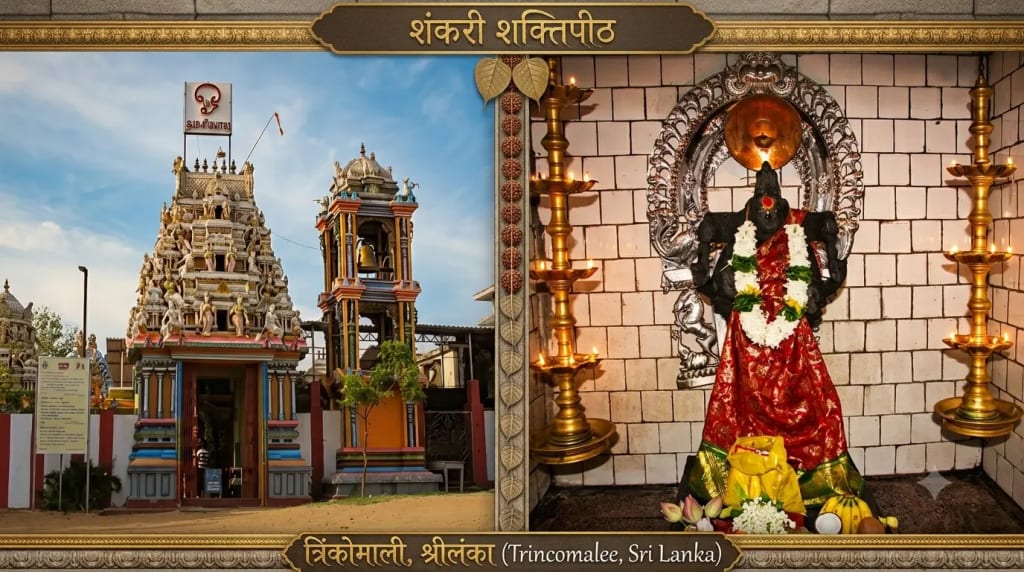
Shankari Shakti Peeth, dramatically perched atop the sheer cliffs of Swami Rock in Trincomalee, Sri Lanka, is revered as the very first of the eighteen Maha Shakti Peethas, marking the sacred spot where Goddess Sati’s thigh or waist (traditionally associated with the groin) fell. Overlooking the azure expanse of the Indian Ocean, this powerful maritime sanctuary is dedicated to Goddess Shankari—the benevolent, peace-bestowing manifestation of Adi Shakti—and guarded by her cosmic protector, Rakshaseshwara Bhairav. The temple grounds blend majestic coastal scenery with intense spiritual vibrations, drawing seekers from around the world to experience its profound healing energies.
🏛️ Overview of the Holy Landscape
Perched high on the rugged volcanic cliffs of Swami Rock, the modern shrine of Shankari Devi is beautifully integrated within the historic Koneswaram temple complex. The site offers breathtaking panoramic views of Trincomalee’s natural deep-water harbor and the boundless ocean below. Visitors are greeted by a soothing marine breeze, the rhythmic crashing of waves against the cliffs, and a highly meditative atmosphere, with the sacred Bilva tree clinging to the edge of the abyss.
📜 The Sacred Legend of Sati’s Thigh/Waist & Goddess Shankari
According to the Puranas and the Ashtadasa Shakti Peetha Stotram by Adi Shankaracharya, when Lord Vishnu severed Sati’s mortal remains, her thigh/waist area fell at this coastal cliff. In spiritual anatomy, this region represents structural support, foundational strength, and grounding energy, establishing the site as a powerhouse for stability and removing life’s deepest obstacles. Here, the Goddess manifests as Shankari (bestower of peace), while Lord Shiva stands guard as Rakshaseshwara Bhairav, stabilizing the southern spiritual quadrant.
⏳ Temple History & Monastic Legacy
The historical legacy of Trincomalee (Thirukonamalai) dates back millennia, with ancient scriptures celebrating it as “Dakshina Kailasha” (the Southern Kailash). Legend holds that the original “Temple of a Thousand Pillars” was built by the demon king Ravana out of immense devotion to Shiva and Shakti. In 1624, during the Portuguese occupation, the majestic cliff-top temple was tragically plundered and demolished, with its stones used to construct Fort Frederick. The sacred idols were safely hidden in a nearby well by local priests and successfully recovered after Sri Lanka’s independence, leading to the rebuilding of the modern shrine in 1952.
✨ Spiritual Significance & Unique Blessings
- The Healing Presence: Worshipped as Kantaka Devi (the remover of thorns), the Goddess is believed to clear physical ailments, psychological trauma, and deep-seated fears.
- Marital Harmony and Progeny: Devotees tie small symbolic cradles and pieces of thread to the sacred Bilva tree at the cliff’s edge, praying for blessed partnerships and childbearing.
- Tantric Resonance: The temple is situated on a unique triangular hill (“Trikona”), making it a highly potent node for advanced energy alignment and meditation.
⏰ Darshan Timings & Daily Rituals
- Public Darshan: Open daily from 06:00 AM to 01:00 PM, and 04:00 PM to 06:45 PM.
- Pratah Puja & Aarti: 06:30 AM. A serene morning ritual conducted as the sun rises over the Indian Ocean.
- Maha Pradosham and Fridays: Special elaborate rituals, shringar (decoration of the deity), and chanting are performed to invoke the divine mother’s active grace.
🚶 How to Reach Shankari Devi Temple
- By Road: Located inside Fort Frederick in Trincomalee, accessible via regular buses and private cabs from Colombo (approx. 260 km) or Kandy (approx. 180 km).
- By Train: Trincomalee Railway Station is the nearest railhead (approx. 3 km away), with direct trains running from Colombo.
- By Air: Bandaranaike International Airport (CMB) in Colombo is the closest international gateway (approx. 240 km), from which domestic flights to China Bay Airport (10 km from the temple) can be chartered.
🗺️ Nearby Places to Visit
- Koneswaram Temple: The main historic Shiva temple situated right beside the Shankari shrine on Swami Rock.
- Fort Frederick: The historic 17th-century fortress built by the Portuguese, through which visitors must walk to reach the temple.
- Kanniya Hot Springs: A set of seven hot wells located about 8 km away, highly linked to Ravana’s legends and cleansing rituals.
- Nilaveli Beach: A pristine, golden-sand beach located 15 km away, famous for whale watching and marine exploration.
💡 Essential Travel Tips
- Plan Around the Focus Keyword: Give yourself plenty of time to explore the entire Swami Rock cliff surrounding the Shankari Shakti Peeth for a complete spiritual and visual experience.
- Footwear and Dress Code: Wear modest, respectful clothing covering shoulders and knees; footwear must be deposited at the entrance of Fort Frederick or the temple path.
- Security Checks: Since the temple is located within a military-administered fort, carry valid identification and expect brief security checks.
- Respect the Wildlife: The fort area is home to gentle, free-roaming deer; feeding them junk food is strictly prohibited.
❓ FAQs
Why is Shankari Shakti Peeth famous?
It is celebrated as the first of Adi Shankaracharya’s 18 Maha Shakti Peethas, historically built on a cliff over the Indian Ocean where Sati’s thigh or waist fell.
Which body part of Goddess Sati fell here?
Her thigh or waist region (traditionally referred to as the groin), symbolizing foundational cosmic strength and life-giving energy.
Who is the Bhairav at this Peeth?
Lord Shiva is worshipped here as Rakshaseshwara Bhairav (also associated with the presiding deity of Koneswaram).
Are there any specific clothing rules for international tourists?
Yes, all visitors must dress modestly (no shorts, sleeveless tops, or short skirts). Sarongs are usually available at the entrance for those needing cover-ups.


